

- Associate Professor | Atmospheric & Planetary Sciences | Center for Atmospheric Sciences
- Research: rarefied atmospheres, exospheres, atmospheric escape, space weather–surface interactions
- Email | Google Scholar | ORCID | Publications
Dr. Orenthal J. (O. J.) Tucker investigates how planetary atmospheres behave at their most extreme limits — where dense atmospheres transition into rarefied gases and ultimately escape to space. He also studies the tenuous atmospheric environments at bodies such as the Moon, Mercury, and Europa, focusing on how surface processes, space weather, and upper-atmospheric physics together control the transport and loss of dust and volatiles. By combining particle-based modeling, atmospheric escape theory, and spacecraft data analysis, this work examines short-timescale physical processes and their connection to long-term planetary evolution and habitability.
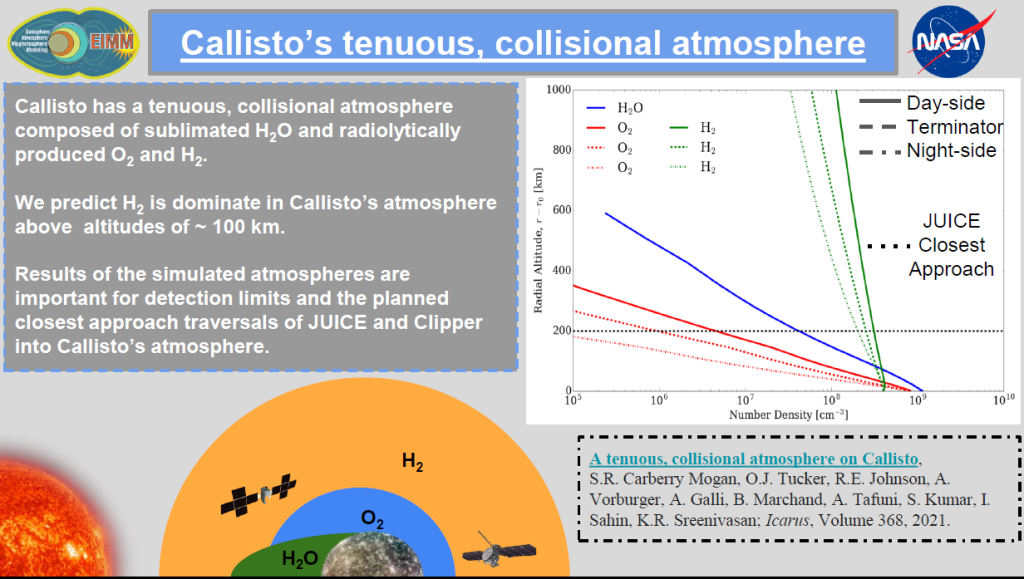
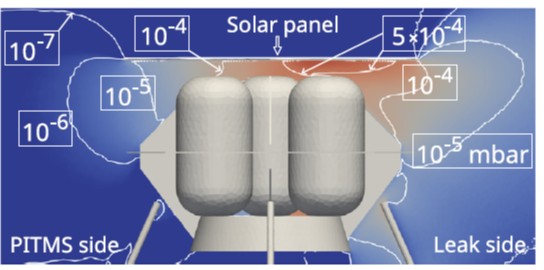
His work spans Titan, Pluto, the Moon, Mercury and the Galilean satellites (Fig. 1), connecting models to mission datasets and laboratory constraints. He has served on mission teams (e.g., Cassini Plasma Spectrometer (CAPS) and Ion Neutral Mass Spectrometer (INMS); Europa Clipper Imaging System EIS) and Commercial Lunar Payload Services investigations (e.g., Peregrine Ion Trap Mass Spectrometer (PITMS), Fig.2), led multi-institutional modeling efforts (EIMM), and several R&A projects (e.g., Solar System Exploration Research Institute SSERVI and NASA ROSES). Recognitions include the Susan Mahan Niebur Award (2022) and the Robert H. Goddard Science Award (2021).
Current Research
- Space Weather & Planetary Surfaces
- How solar wind, radiation, and micrometeoroid impacts modify planetary surfaces and release atoms and molecules into space.
- Lunar & Planetary Exospheres
- Understanding how extremely thin atmospheres form, evolve, and transport material across planetary bodies.
- Modeling to Mission Connection
- Using physics-based models to directly support spacecraft observations and future mission planning.
- Atmospheric Escape
- Using physics-based models to examine atmospheric escape theory under non-equilibrium conditions.
Depending on interests, students may:
- Develop numerical models of particle transport and surface–exosphere interactions
- Analyze spacecraft data from lunar and planetary missions
- Help design and evaluate new instruments for measuring dust and volatiles
- Explore how surface processes connect to broader questions of atmospheric evolution and habitability
Projects are structured so that undergraduates, Master’s students, and Ph.D. students can all contribute meaningfully, with clear paths toward conference presentations, publications, and mission involvement.
Fig. 1: Callisto’s Tenuous Atmosphere
https://doi.org/10.1016/j.icarus.2021.114597
Fig. 2: Direct Simulation Monte Carlo (DSMC) Models of a Lunar Lander Gas Leak
Background
O. J. Tucker earned a B.S. in Math–Physics from Hampden-Sydney College (2002) and graduate degrees in Engineering Physics at the University of Virginia (M.S. & Ph.D.) (2012). His Ph.D. dissertation, Escape from Titan’s Atmosphere: Kinetic Monte Carlo Simulations, established the rarefied-gas/DSMC foundation for his later exosphere studies. After the Ph.D., Tucker served as a Postdoctoral Researcher and then Research Scientist at the University of Michigan (2012 – 2017), followed by a Research Scientist role at the University of Virginia (2017). He subsequently moved to NASA’s Goddard Space Flight Center, first as a NASA Postdoctoral Fellow (2017 – 2018), then in the role of civil servant as Research Scientist, and later Associate Lab Chief of the Planetary Magnetospheres Laboratory (2018 – 2025). He joined the Atmospheric & Planetary Sciences at Hampton University as an Associate Professor in Fall 2025.